
Body-contouring surgery
Thigh lift
For a more balanced leg shape and greater freedom of movement.
After liposuction for lipoedema, substantial weight loss or increasing loss of elasticity, excess skin may remain. This can affect the leg contour, movement and everyday comfort.

- Stay
- Usually 2–3 nights
- Anaesthesia
- General anaesthesia
- Operating time
- Approx. 3–4 hours
- Compression
- Usually around 6 weeks
When excess skin affects everyday life
After liposuction, particularly in connection with lipoedema, after substantial weight loss or through age-related loss of elasticity, excess skin may remain on the thighs.
This excess skin can make the contour appear less smooth, cause friction during movement, create bothersome folds, or limit clothing choices and certain activities.
Pronounced excess skin cannot be removed reliably with sport, creams or non-surgical treatments. Even so, visible or bothersome excess skin does not automatically mean that surgery is appropriate or necessary. The key question is whether the expected benefit justifies the operation and the resulting scars from both a medical and personal perspective.
What a thigh lift can address
Which areas can be improved depends on the distribution of excess skin and your individual tissue quality. The goal is not a standardised leg shape, but a contour that suits your proportions and may allow greater freedom of movement.
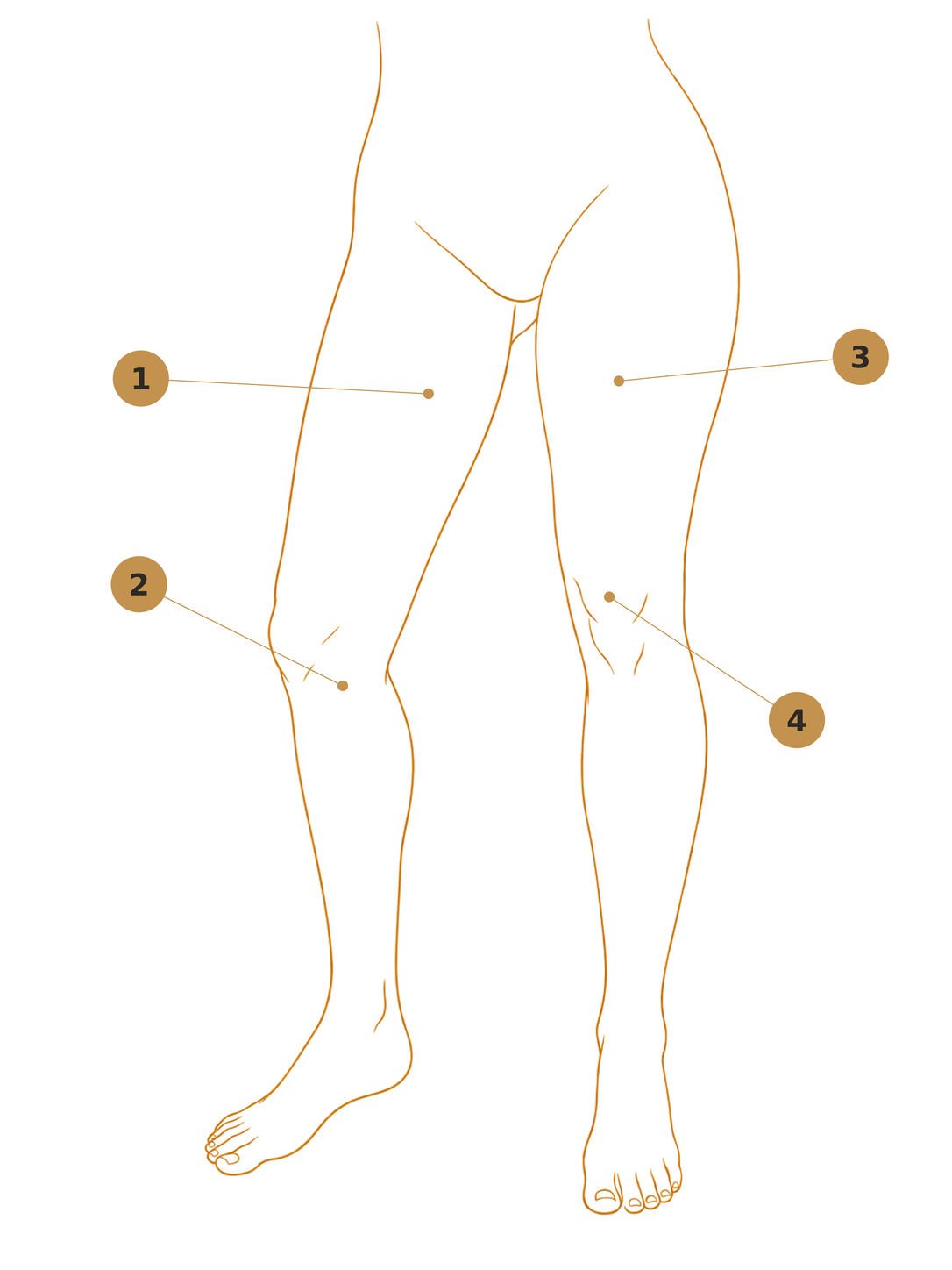
Greater freedom of movement
Bothersome excess skin on the inner thighs can be removed, which may reduce friction during movement.
A more balanced leg contour
The transition from the thigh to the inner knee may appear smoother and more balanced.
A smoother skin appearance
The skin on the front of the thigh may look smoother and firmer.
Fewer skin folds above the knee
Bothersome folds above the knee may be reduced.
Which approach may be right for you?
The most suitable approach depends on the extent of the excess skin. The key question is whether the change is limited to the thigh or continues beyond the knee.
Vertical thigh lift
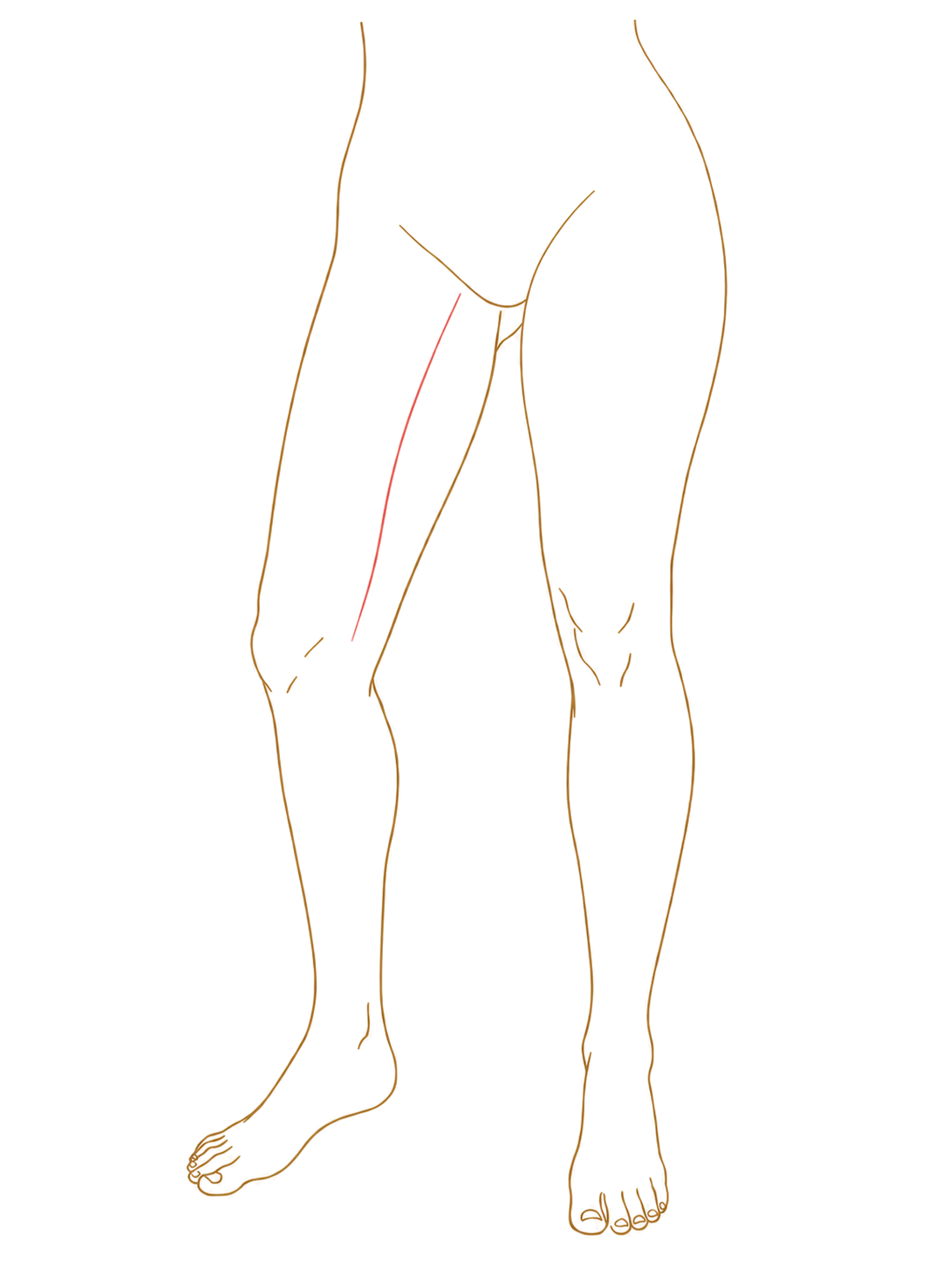
A vertical thigh lift is the standard approach for pronounced excess skin along the thigh.
The scar runs along the inner side of the leg, rather like a trouser seam, from the inner knee to the upper thigh close to the groin.
Through the vertical incision, excess skin can be removed along the length of the thigh. The aim is a harmonious contour that suits your proportions, not a standardised leg shape.
Extended thigh and lower-leg lift
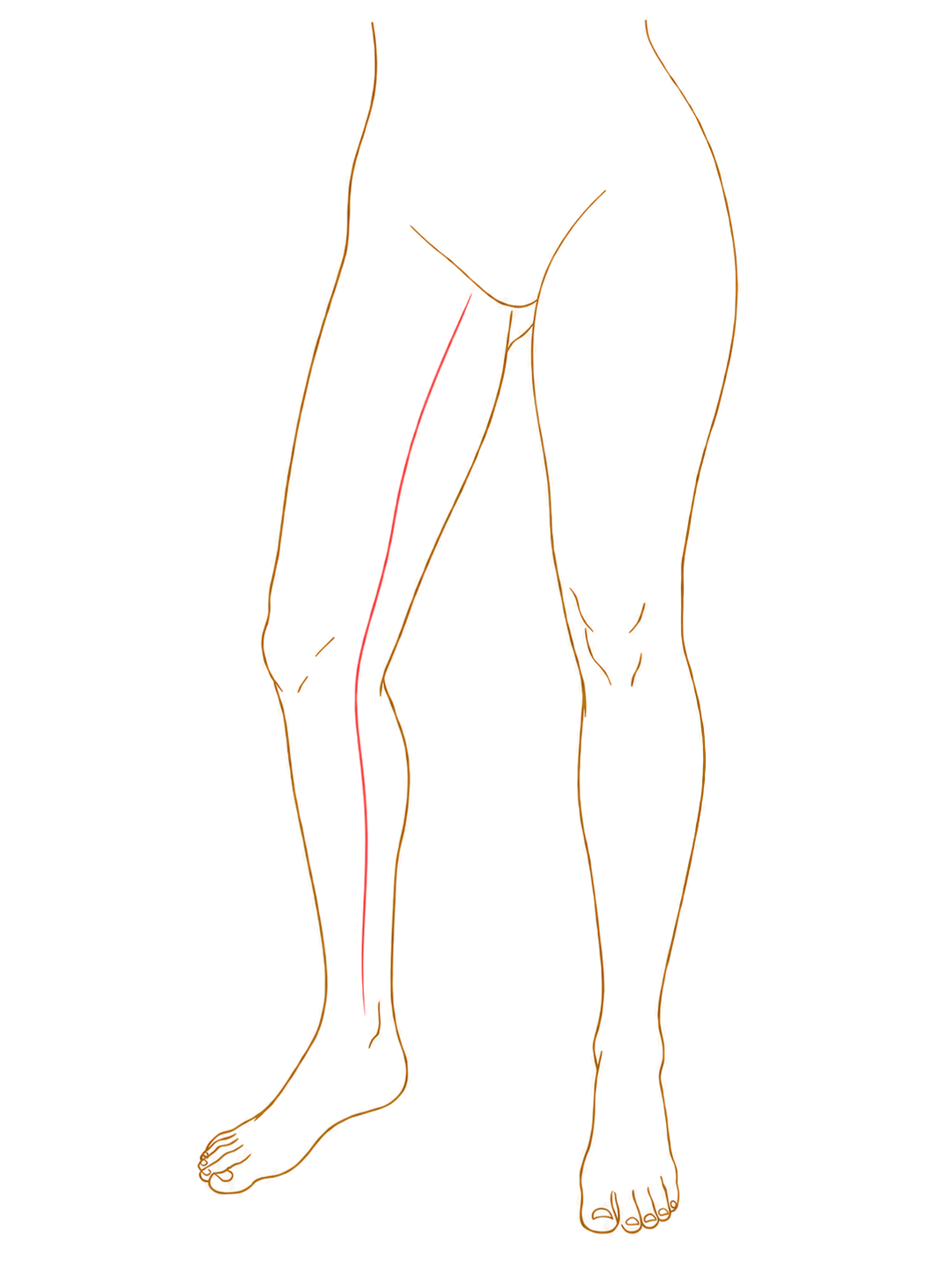
If the excess skin continues beyond the knee, the lift may be extended to the inner lower leg.
This is not automatically necessary. The extent is determined by examination, tissue quality and individual planning.
The aim is a balanced transition across the knee and lower leg, while avoiding a longer scar than is justified by the expected functional and aesthetic benefit.
Experience centred on you.
When planning a thigh lift, I examine the whole leg. The decisive factors are the distribution and direction of the excess skin, skin and tissue quality, previous operations, side-to-side differences and which areas can realistically be improved.
We look at the front and back of the thigh, the inner thigh, the knee and, where appropriate, the lower leg as well. Not every zone can be changed to the same degree. Lateral improvement in particular is more limited and is assessed realistically during individual planning.
You receive a clear assessment of the scar length likely to be required and whether the expected functional and aesthetic benefit justifies the procedure. If surgery is not advisable, I will say so openly.

Your treatment journey
Personal consultation
We discuss which symptoms or limitations you notice in everyday life and what change you would like to achieve.
After the examination, you receive a realistic assessment of whether a thigh lift is medically appropriate for you.
Individual planning
Planning takes account of excess skin, tissue quality, weight history, nicotine use, previous operations, wound-healing risks, thrombosis risk and the possible extent of tightening.
After substantial weight loss, the target weight should usually have been reached and remained stable for at least six months. Well-founded exceptions can be considered in individual cases.
Operation
A thigh lift is performed under general anaesthesia and usually takes around three to four hours. If the lift is extended to the lower leg, the operation may take longer.
The operation is always liposuction-assisted: the area where skin is to be removed is first prepared with liposuction. The excess overlying skin is then removed.
Inpatient care
A hospital stay of two to three nights is usually recommended.
The exact treatment setting depends on the extent of surgery, your medical history and the early course of healing.
Personal aftercare
After surgery, wound healing, swelling, skin sensation, mobility, compression and scar development are checked.
Recommendations on physical strain are adapted to your actual healing progress.
Recovery and returning to everyday life
The first few days
Swelling, a feeling of tightness and bruising are normal after surgery.
Short early walks are encouraged and support circulation and mobilisation. Prolonged standing, deep bending of the legs and physical strain should initially be avoided.
Compression
A fitted compression garment is usually worn for around six weeks.
At first, this is usually day and night. Later, depending on swelling, tissue response and healing, compression can often be reduced to daytime use.
Everyday life and work
With predominantly sedentary or physically light work, returning after around two weeks is often possible.
Physically demanding work or an extended procedure may require a longer recovery period.
Sport and physical strain
Light exercise is often possible after two to three weeks, provided it does not place strain on the legs.
Intensive sport and targeted leg training are usually resumed gradually only after six to eight weeks. Your return to exercise should be guided by medical clearance during follow-up.
Development of the result
The new contour is visible early, but is initially affected by swelling and tissue firmness.
Over the following months, the tissue continues to settle. Natural ageing and larger later weight changes can alter the result.
Scars and scar care
With a vertical thigh lift, the scar runs along the inner side of the leg. Its length depends on the extent of the excess skin. If treatment is extended to the lower leg, the scar is lengthened accordingly.
Scars are usually red, firmer and more visible at first. Scar maturation takes around six to twelve months, sometimes longer. Silicone gel or silicone sheets may be helpful. Scar massage should begin only after medical clearance. Consistent UV protection is important so the scar does not become permanently more pigmented. Scars remain visible.
A tissue-preserving approach to a more balanced leg contour
A thigh lift is performed with a tissue-preserving approach refined through years of surgical experience.
The procedure is always liposuction-assisted. First, the area where skin is to be removed is prepared by liposuction. The excess overlying skin is then removed while deeper tissue bridges are preserved as far as possible.
This tissue-preserving technique aims to reduce stress on lymphatic structures and may lower the risk of seromas and lymphatic drainage problems. It can never eliminate these complications.
When the individual findings and course of surgery allow, drains are not routinely used.
When a lift may be considered after liposuction
After previous liposuction, the tissue needs enough time to settle and adapt to the changed contour.
Assessment is generally appropriate after around six months. By that point, swelling should largely have subsided. Skin and tissue quality can then be assessed more reliably, allowing any lift to be planned on a firmer basis.
Not every patient needs an additional lift after liposuction.
Carefully planned. Personally supported.
Before a thigh lift, weight history, comorbidities, previous operations, skin quality, the planned extent of treatment, wound-healing risks, thrombosis risk and anaesthetic risks are considered carefully.
There is no single BMI cut-off that can be applied safely to every patient. With higher body weight and relevant comorbid factors, however, operative risks increase. The decision must therefore be made individually and on medical grounds.
Complete nicotine abstinence is important for wound healing. This includes cigarettes, e-cigarettes, nicotine pouches or comparable nicotine products, as well as nicotine replacement products unless they have been specifically agreed as part of your medical care. The recommendation is usually four to eight weeks before surgery and at least four weeks afterwards; a longer period may be appropriate in individual cases.
Possible risks include wound-healing problems, conspicuous or widened scars, temporary or persistent swelling, sensory changes, asymmetry, contour irregularities, seromas, lymphatic drainage problems, thrombosis and pulmonary embolism. In some cases, a later minor corrective procedure may be appropriate.
During the personal consent discussion, these risks are explained in relation to your individual situation.
Costs
The cost of a thigh lift depends on the extent of excess skin, the scope of surgery, any extension to the lower leg, anaesthesia and the hospital stay.
After examination, you receive a transparent individual cost estimate.
Predominantly aesthetic treatment is self-funded.
Frequently asked questions
When is a thigh lift appropriate after liposuction?
After liposuction, the tissue needs enough time to settle and adapt to the new contour.
Assessment is usually appropriate after around six months, once swelling has largely subsided and skin and tissue quality can be judged more reliably. Not every patient needs a lift afterwards.
Where does the scar run?
With a vertical thigh lift, the scar runs along the inner side of the leg, rather like a trouser seam, from the inner knee to the upper thigh close to the groin.
With an extended leg lift, the scar may be lengthened beyond the knee onto the inner lower leg when the findings make this appropriate.
How long will the scar be?
Scar length depends on the extent and direction of the excess skin.
It is planned to be as short as medically appropriate, but it must be long enough to treat the bothersome excess skin effectively.
Can the lift be extended to the lower leg?
Yes. If the excess skin continues beyond the knee onto the inner lower leg, treatment can be extended.
This is not automatically necessary. The decision is based on examination, tissue quality and the balance between additional scar length and expected benefit.
When can I work again?
With predominantly sedentary or light work, returning after around two weeks is often possible.
Physically demanding work may require a longer break. The decisive factors are the extent of surgery and the course of healing.
How long do I need to wear compression?
Compression is usually worn for around six weeks.
At first this is usually day and night. Later, depending on swelling and healing, it can often be reduced to daytime use.
When can I do sport again?
Short walks are encouraged early.
Light sporting activity is often possible after two to three weeks, initially without loading the legs. Intensive sport and targeted leg training are usually resumed gradually only after six to eight weeks.
Should my weight be stable before surgery?
After significant weight loss, the target weight should have been reached and should usually have remained stable for at least six months.
Well-founded exceptions can be considered in individual cases. Weight history and associated risks are assessed medically during planning.
How long does the result last?
With stable weight, the improved contour may be long lasting.
Natural ageing processes and larger later weight changes can alter the skin and leg shape again.